Quilt backing calculator
Enter your quilt size to see how much backing fabric to buy. It checks seams running down and across, and tells you which uses less.
Backing
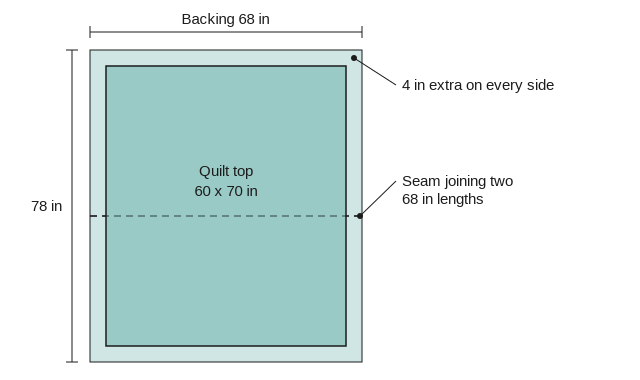
The backing should be 68 x 78 in: your 60 x 70 in quilt plus 4 in on each side.
In each drawing the dark outline is the backing after trimming, the inner box is your quilt, and dashed lines are seams and offcuts.
With 108 in wide backing you would buy 2 yd (1.83 m) and need no seams.
Yardage is rounded up to the next 1/8 yd. Seams use a 1/2 in allowance, which takes 1 in off the joined width. Fabric width 42 in after trimming selvages.
How it works
The backing size is the quilt size plus the extra on every side. If that is wider than your fabric, you sew lengths side by side. Each seam uses 1/2 in on each piece, so two 42 in widths join to 83 in, not 84 in.
The calculator tries both directions. With seams running top to bottom, each length is as long as the backing. With seams running side to side, each length is as long as the backing is wide. It shows both and marks the one that needs less fabric.
Backing for common quilt sizes
With 4 in extra on each side. "Cotton" is 42 in wide fabric using the cheaper seam direction.
| Quilt (in) | Backing (in) | Cotton | 108 in wide |
|---|---|---|---|
| 36 x 52 baby | 44 x 60 | 2 1/2 yd | 1 1/4 yd |
| 60 x 70 throw | 68 x 78 | 3 7/8 yd | 2 yd |
| 68 x 90 twin | 76 x 98 | 5 1/2 yd | 2 1/8 yd |
| 84 x 90 full | 92 x 98 | 7 3/4 yd | 2 5/8 yd |
| 90 x 95 queen | 98 x 103 | 8 1/4 yd | 2 3/4 yd |
| 106 x 95 king | 114 x 103 | 8 5/8 yd | 3 1/4 yd |
A king backing is 114 in wide, more than 108 in fabric. Turn the fabric so the 108 in runs down the length of the quilt and buy one 114 in piece. That is the 3 1/4 yd in the table, with no seam.
Questions
How much backing fabric do I need for a queen quilt?
For a 90 x 95 in quilt with 4 in extra on each side, the backing is 98 x 103 in. From 42 in wide cotton that takes three lengths of 98 in sewn with seams running across: 8 1/4 yd. With 108 in wide backing it is one piece and 2 3/4 yd.
How much backing for a throw quilt?
A 60 x 70 in throw needs a 68 x 78 in backing. Two lengths of 68 in with one seam across the middle use 3 7/8 yd of 42 in fabric. Running the seam down the middle needs two 78 in lengths, 4 3/8 yd.
Should backing seams run vertically or horizontally?
Whichever uses less fabric, unless the print has a direction. The fabric is cut in lengths across the bolt, so the length of each piece is what you pay for. When the quilt is longer than it is wide, a seam across the middle often means shorter pieces.
Why does the backing need to be bigger than the quilt?
The layers shift a little as you quilt, and a longarm frame needs fabric to clamp. With no extra, the backing can end up short at one edge. Trim the extra off after quilting, before you bind.
Is wide backing worth it?
It costs more per yard but you buy far less of it, and there is no seam. For a queen quilt you buy 2 3/4 yd of 108 in backing instead of 8 1/4 yd of 42 in cotton. Compare the two prices at your shop.
Can I piece a backing from leftover fabric?
Yes. Sew the pieces into a panel at least the size this calculator gives, and keep large pieces near the middle, because the edges get trimmed off.