Quilt calculator
Enter the size you want and your block size. You get the number of blocks, the real finished size, and how much fabric to buy for sashing, borders, backing and binding.
Your quilt
20 blocks: 4 across and 5 down. Finished size 60 x 74 in (152 x 188 cm).
| Part | What to cut | Buy |
|---|---|---|
| Plain square blocks | 20 squares cut 12 1/2 in. Cut 7 strips 12 1/2 in wide, 3 squares per strip. | 2 1/2 yd (2.29 m) |
| Sashing | 15 pieces 2 1/2 x 12 1/2 in between blocks, and 4 long strips 2 1/2 x 54 1/2 in between rows. Cut 11 strips 2 1/2 in wide and join strips for the long pieces. | 7/8 yd (0.80 m) |
| Border | Cut 7 strips 3 1/2 in wide and sew them end to end. Cut 2 at 68 1/2 in for the sides, then 2 at 60 1/2 in for the top and bottom. | 3/4 yd (0.69 m) |
| Backing | 2 lengths of 68 in, sewn together with a horizontal seam (1/2 in seam allowance). Trim to 68 x 82 in. | 3 7/8 yd (3.54 m) |
| Binding | Cut 8 strips 2 1/2 in wide. Join with diagonal seams to get about 318 in. The edge is 268 in. | 5/8 yd (0.57 m) |
| Batting | At least 68 x 82 in, the same as the backing. | Twin pack, about 72 x 90 in |
Your target was 60 x 70 in. 3 across makes it 46 in wide, 5 across makes it 74 in wide. 4 down makes it 60 in long, 6 down makes it 88 in long.
Backing with horizontal seams needs 3 7/8 yd (3.54 m). With vertical seams it needs 4 5/8 yd (4.23 m).
Cut sizes include 1/4 in seam allowances. Yardage is rounded up to the next 1/8 yd, for fabric 42 in wide after you trim the selvages.
How the block count works
The calculator takes the border off your target size, then fits in as many blocks and sashing strips as it can, rounded to the nearest whole block. Blocks don't stretch, so the finished quilt is rarely exactly the size you typed.
Take a 60 x 70 in throw with 12 in blocks, 2 in sashing and a 3 in border. That fits 4 blocks across and 5 down, and the quilt comes out 60 x 74 in. The result shows what one block more or fewer does to each side, so you can pick the size you prefer.
If you already have the blocks, choose "A block count" and enter how many go across and down. That suits block-of-the-month kits and a pile of orphan blocks.
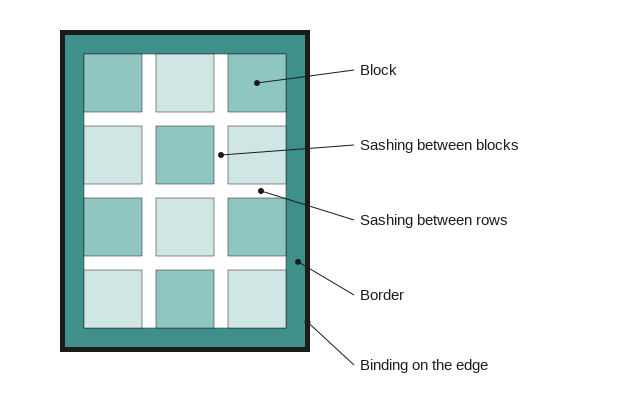
What each line of the result means
- Blocks
- Fabric for blocks that are each one plain square, like a simple patchwork. For pieced blocks, use the yardage in your pattern.
- Sashing
- Short pieces go between the blocks in each row. Long strips go between the rows and run the full width of the center.
- Border
- Strips cut across the fabric and sewn end to end. Sew the side borders on first, then the top and bottom, which is why those two are longer.
- Backing
- The quilt size plus the extra you set on every side. The calculator tries the seam both ways and shows the one that uses less fabric.
- Binding
- Strips joined with diagonal seams, long enough to go around the quilt with 12 in to spare.
- Batting
- Cut to the same size as the backing.
Quilt sizes in the size list
| Size | Quilt (in) | Fits |
|---|---|---|
| Baby or crib | 36 x 52 | Crib mattress 28 x 52 in, or a play mat |
| Throw or lap | 60 x 70 | Sofa or lap |
| Twin | 68 x 90 | Twin mattress with 15 in over each side and the foot |
| Full or double | 84 x 90 | Full mattress, same 15 in drop |
| Queen | 90 x 95 | Queen mattress, same 15 in drop |
| King | 106 x 95 | King mattress, same 15 in drop |
| California king | 102 x 99 | California king mattress, same 15 in drop |
For a longer drop or a pillow tuck, use the quilt size chart, then come back with your size.
Questions
How many blocks do I need for a queen size quilt?
With 12 in blocks and no border, 8 across and 8 down: 64 blocks for a 96 x 96 in quilt. Add a 4 in border and 7 by 7 is closer to queen size: 49 blocks and a 92 x 92 in quilt. Put your own block size and border into the calculator, because a 2 in change in either one moves the count.
How many 10 inch blocks for a twin quilt?
63 blocks, 7 across and 9 down, make a 70 x 90 in quilt with no sashing or border. That covers the top of a twin mattress and hangs about 16 in over each side.
How much backing fabric do I need?
Take the quilt size and add 4 in on every side. A 60 x 70 in throw needs a 68 x 78 in backing. From 42 in wide cotton, two lengths of 68 in sewn with a seam across the middle use 3 7/8 yd. Two lengths of 78 in with the seam running down use 4 3/8 yd. The backing calculator compares both layouts and wide backing for any size.
How much binding do I need?
Measure all four sides, add them up and add 12 in for the corners and the final join. A 60 x 70 in quilt has 260 in of edge, so you need 272 in: seven 2 1/2 in strips, or 1/2 yd of fabric. The binding calculator also does bias binding.
What size batting should I buy?
The same size as the backing: 4 in bigger than the quilt on every side. The calculator names the smallest common batting pack that fits. Pack sizes differ a little between brands, so check the label.
Does the calculator add seam allowance?
Yes. You enter finished sizes, and every cut size in the result includes a 1/4 in seam allowance. Backing seams use 1/2 in.
Should I buy extra fabric?
The result is rounded up to the next 1/8 yd but has no spare for mistakes or shrinkage. If you prewash, or the shop tends to cut crooked, buy an extra 1/8 to 1/4 yd of each fabric.
Can I type fractions or use centimeters?
You can type 12 1/2, 12.5 or 12½. The calculator works in inches. To convert centimeters, divide by 2.54. Fabric amounts show yards and meters.